


Welcome to Our Blog
Insights and tips to keep your living environment safe and healthy.
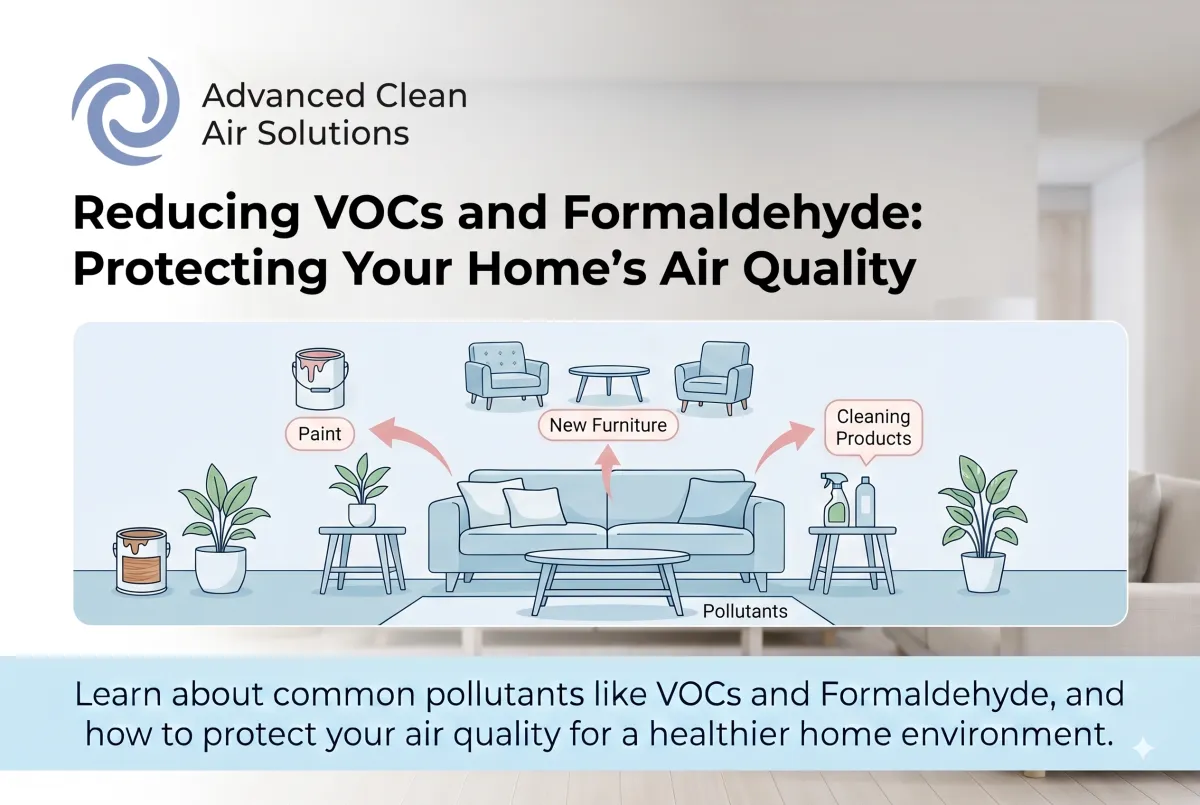
Reducing VOCs and Formaldehyde: Protecting Your Home’s Air Quality
Introduction
Indoor air quality is easy to overlook until something in your home starts to feel a little off. One common source of indoor air pollution is Volatile Organic Compounds (VOCs), gases released by many everyday products, building materials, furnishings, and household chemicals.
While low levels of VOCs are common in most homes, higher concentrations can contribute to headaches, irritation, unpleasant odors, and other health concerns. In this article, we’ll explain what VOCs are, where they come from, when it may be worth taking a closer look, and practical steps you can take to create healthier indoor air.
What Are VOCs?
Volatile Organic Compounds, or VOCs, are chemicals that can easily evaporate into the air at room temperature. They’re released by many common household products and materials, including paint, cleaning products, glues and adhesives, furniture, flooring, insulation, and other building materials.
One VOC you may have heard of is formaldehyde, which can be found in certain pressed-wood products, furnishings, and building materials. At elevated levels, VOCs such as formaldehyde can contribute to eye, nose, and throat irritation and may affect respiratory comfort.
How Mold Can Be a Hidden Source of VOCs
Not all VOCs come from products like paint, furniture, or cleaning supplies. As mold grows, it can also release microbial volatile organic compounds (mVOCs) into the air.
Because mold often grows in hidden areas such as behind walls, under flooring, or around moisture-damaged materials it isn’t always immediately visible. mVOCs are one of the contributors to the familiar musty or earthy odor often associated with mold growth.
If you notice a persistent musty smell in your home, it may be worth investigating further. Professional mold testing can help determine whether hidden mold is present and provide more information about the types of mold found in the environment.
VOC Testing and Indoor Air Quality Testing: What We Can and Can’t Tell You
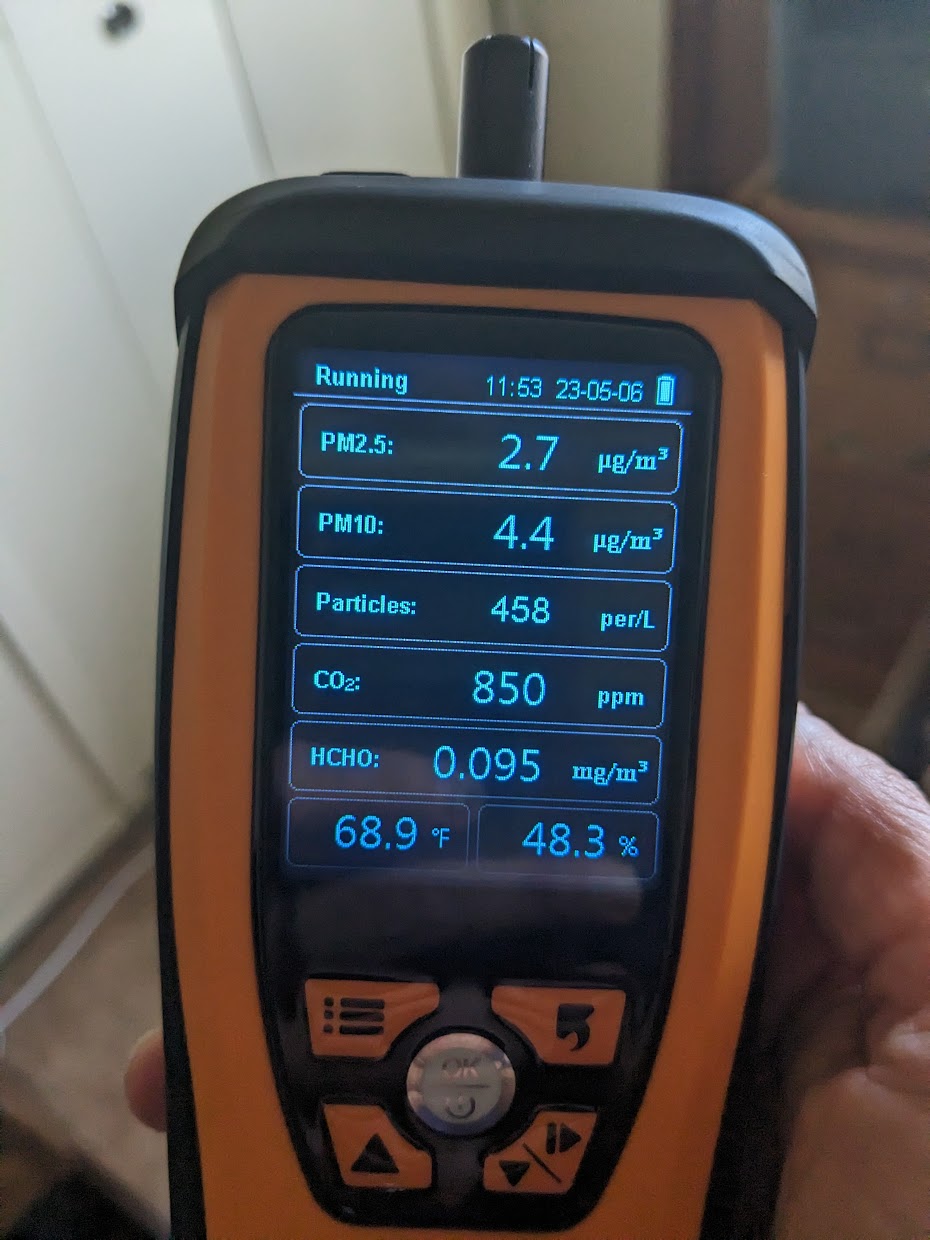
If you’re concerned about VOCs, chemical odors, off-gassing, or unusual indoor air quality, the first thing to understand is that there are different levels of testing.
At Advanced Clean Air Solutions, we can perform an on-site indoor air quality assessment that provides valuable screening information about VOCs and formaldehyde, along with testing for airborne mold spores, particulate matter, and other particles in the air. Taken together, these results can provide a much broader picture of what is happening in your indoor environment.
However, our testing is not the same as specialized laboratory chemical analysis. We believe it’s important for clients to understand that distinction before scheduling.
What Our VOC and Formaldehyde Testing Can Tell You
Our professional instruments can screen for total VOC levels and measure formaldehyde in your home. We can take readings in areas of concern and compare them with other areas of the home and, when useful, outdoor air.
This can help answer questions such as:
Are VOC readings noticeably higher in one room or area?
Is formaldehyde detected at an elevated level?
Do readings differ between an area with a new material or unusual odor and an unaffected part of the home?
Is there a pattern that suggests further investigation may be worthwhile?
This type of testing is particularly useful as a screening tool. It gives us another piece of information to consider alongside the history of the property, recent renovations or installations, odors, moisture conditions, and our other indoor air testing.
What Our VOC Testing Cannot Tell You
A general total VOC (TVOC) reading cannot identify every individual chemical in your air or definitively tell you which product is responsible for off-gassing. TVOCs include a very large number of different compounds, and no single field instrument measures all of them equally.
For example, if you are concerned about spray foam insulation off-gassing, our equipment cannot specifically test for compounds such as isocyanates (including MDI) or TCPP flame retardants. Determining whether particular chemicals like these are present and measuring their individual concentrations requires specialized sampling methods and laboratory analysis that we do not currently offer.
So, while our TVOC screening can provide an important data point, we cannot use it to say, “This exact chemical is coming from this exact material at this concentration.”
In some cases, particularly when there is a concern about a newly installed building product, we recommend contacting the manufacturer or installer to ask about product-specific testing or warranty inspection options.
Looking Beyond VOCs: Getting a Broader Picture of Your Indoor Air
One of the advantages of an Advanced Clean Air Solutions assessment is that we don’t have to look at VOCs in isolation.
A musty or unusual odor, for example, doesn’t necessarily mean that a building material is off-gassing. Mold can also release microbial volatile organic compounds (mVOCs) as it grows, and hidden moisture or mold may be another piece of the puzzle.
That’s why our indoor air quality testing can also evaluate airborne mold spores and particulate matter, giving you a much more complete picture of the air you’re breathing.
Mold Air Testing: 90+ Mold and Fungal Spore Types
Our mold air samples can be analyzed for more than 90 mold and fungal spore types and categories, including many commonly associated with indoor moisture problems.
These can include:
Aspergillus/Penicillium, Stachybotrys, Chaetomium, Cladosporium, Alternaria-like spores, Fusarium, Scopulariopsis, Wallemia, Ulocladium, Curvularia, Epicoccum, Paecilomyces, Basidiospores, Ascospores, and many more.
Particulate Matter and Other Airborne Particles
Our indoor air quality evaluation can also provide information about particulate matter and other airborne particles, including particle sizes and a variety of materials that may be present in the air, including:
pollen, animal skin fragments, human skin fragments, insect parts, carbon particles, and other airborne particulates.
These findings can be especially helpful when someone knows that the air in their home doesn’t feel right, but there isn’t one obvious explanation.
Putting the Pieces Together
Indoor air quality concerns are rarely explained by just one factor. VOCs, formaldehyde, mold spores, particulate matter, moisture, recent construction, new furnishings, and even outdoor air conditions can all influence what you’re experiencing inside your home.
That’s why we believe in looking at the whole picture, rather than relying on a single meter reading or test result.
At Advanced Clean Air Solutions, we test, report, and explain. By combining VOC and formaldehyde screening with mold and particulate testing and considering what is happening in and around the property we can help you better understand your indoor environment and determine whether the findings suggest a problem that can be addressed, a need for further investigation, or more specialized testing.
Outdoor air can provide useful context, too. If you’re experiencing irritation, headaches, odors, or other concerns, it can be helpful to know whether local conditions may also be contributing. The EPA’s AirNow website allows you to enter your ZIP code and view current levels of ozone and particulate pollution, along with easy-to-understand health guidance.
You can check your local outdoor air quality at AirNow.gov.
If you’re concerned about VOCs, off-gassing, mold, unusual odors, or your home’s overall air quality, contact Advanced Clean Air Solutions. We can help you understand what our testing can evaluate and whether an indoor air quality assessment is the right next step.
Reducing VOCs in Your Home
There are several practical ways to help reduce VOCs and support healthier indoor air:

Improve Ventilation: When outdoor conditions allow, open windows and use exhaust fans to help move indoor pollutants out and bring fresh air in.
Choose Lower-VOC Products: When selecting paint, flooring, furniture, cleaning products, or other household materials, look for options labeled low-VOC, zero-VOC, or formaldehyde-free.
Consider a Multi-Stage Air Purifier: Because VOCs, mold spores, odors, and airborne particles behave differently, no single type of filtration addresses everything.
At Advanced Clean Air Solutions, we offer an ActivePure air scrubber that combines several complementary technologies, including:
HEPA filtration to capture fine airborne particles such as dust, pollen, and mold spores
Activated charcoal/carbon filtration to help reduce VOCs, chemical odors, smoke, and other gaseous pollutants
Ionization to help address airborne particles
PCO Technology provides an additional layer of air and surface purification that reduces mold, bacteria, viruses, and other contaminants.
Together, these technologies provide broader indoor air quality support than a basic HEPA filter alone.
Learn more about the ActivePure air scrubber we recommend
When You Want a Clearer Picture of Your Indoor Air
Sometimes there isn’t one obvious source of an indoor air quality problem. An unusual odor, recent renovation, moisture issue, or unexplained irritation may involve several different factors. That’s when taking a broader look at your indoor environment can be especially helpful.
At Advanced Clean Air Solutions, we test, report, and explain. Our independent indoor air quality assessments can help give you a more complete picture of what may be happening in your home, from mold and airborne particles to VOCs and other potential indoor air quality concerns.
Our goal is to help you move beyond guesswork. Once you have a clearer understanding of what’s in your air and where potential problems may be coming from, you can make informed decisions about the best next steps for your home.
Concerned about your indoor air? Contact Advanced Clean Air Solutions to learn more about our comprehensive indoor air quality testing and PCO air purification options.

Copyright @ 2026 - All rights reserved
Advanced Clean Air Solutions, LLC
351 Paseo Nuevo 2nd Floor #1033
SANTA BARBARA, CA 93101


